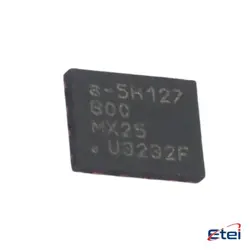
Images are for reference only
ATMEGA88-20MU
+BOMIC MCU 8BIT 8KB FLASH 32VQFN
-
ManufacturerMicrochip Technology
-
Mfr. Part #ATMEGA88-20MU
-
Datasheet ATMEGA88-20MU DataSheet
-
In Stock7290
365 Days Quality Guarantee
7*24 hours service quarantee
90-day after-sales guarantee
Genuine Product Guarantee
Specifications
| Attribute | Value |
| Series | AVR® ATmega |
| Part Status | Active |
| Digi Key Programmable | Verified |
| Core Processor | AVR |
| Core Size | 8-Bit |
| Speed | 20MHz |
| Connectivity | I2C, SPI, UART/USART |
| Peripherals | Brown-out Detect/Reset, POR, PWM, WDT |
| Number of I/O | 23 |
| Program Memory Size | 8KB (4K x 16) |
| Program Memory Type | FLASH |
| EEPROM Size | 512 x 8 |
| RAM Size | 1K x 8 |
| Voltage - Supply (Vcc/Vdd) | 2.7V ~ 5.5V |
| Data Converters | A/D 8x10b |
| Oscillator Type | Internal |
| Operating Temperature | -40°C ~ 85°C (TA) |
| Mounting Type | Surface Mount |
| Supplier Device Package | 32-VQFN (5x5) |
| Package / Case | 32-VFQFN Exposed Pad |
| Base Product Number | ATMEGA88 |
Overview
Description
The ATMEGA88-20MU is equipped with a wide range of peripherals, such as timers, counters, a USART, SPI interface, and I2C compatibility, making it versatile for various applications. It also includes a 10-bit ADC, which supports up to 8 single-ended channels, for applications requiring analog-to-digital conversion.
The microcontroller supports a wide operating voltage range from 1.8V to 5.5V, offering flexibility in different power environments. Its compact VQFN (Very Thin Quad Flat No-Lead) package allows for space-efficient designs. Additionally, the device features advanced RISC architecture, providing 131 powerful instructions, mostly executed in a single clock cycle. The ATMEGA88-20MU is widely used in consumer electronics, automotive, and industrial applications due to its reliability and ease of integration.
Equivalent
1. ATMEGA88PA-AU: A similar variant with power-saving features.
2. ATMEGA168-20AU: Offers more memory but similar architecture.
3. ATTINY88-MU: A smaller package alternative with fewer peripherals.
4. PIC16F1947: From Microchip, offering similar functionality.
5. STM8S103F3: From STMicroelectronics, comparable 8-bit microcontroller.
These alternatives may differ in features, packaging, or power consumption, so verification is needed for specific application requirements.
Features
The ATmega88-20MU offers 23 general-purpose I/O lines and supports various communication interfaces, such as SPI, I2C (TWI), and USART, making it versatile for different applications. It also has a 6-channel 10-bit ADC, providing analog-to-digital conversion capabilities. Other features include a programmable watchdog timer with an internal oscillator, multiple power-saving modes, and enhanced power management options.
This microcontroller is suitable for compact designs, offering a QFN32 package that is surface-mountable, providing flexibility in circuit design. It operates in a voltage range of 1.8V to 5.5V, making it ideal for low-power applications. The ATmega88-20MU is often used in embedded systems, consumer electronics, and industrial automation.
Pinout
Key functionalities include:
1. CPU: 8-bit AVR architecture.
2. Memory:
- Flash: 8KB for program storage.
- SRAM: 1KB for data storage.
- EEPROM: 512 bytes for non-volatile data storage.
3. Timers: Three timers (one 16-bit and two 8-bit) for timing and waveform generation.
4. Communication Interfaces:
- USART for serial communication.
- SPI for synchronous data communication.
- I2C (TWI) for interfacing with other peripherals.
5. ADC: 10-bit Analog-to-Digital Converter with up to 8 channels for analog signal processing.
6. PWM: Pulse Width Modulation outputs for motor control and signal modulation.
7. Interrupts: External and pin-change interrupts for responsive applications.
8. Oscillator: Can operate with an internal or external clock source.
These features make it suitable for embedded systems, robotics, and industrial automation applications.
Manufacturer
Application
1. Embedded Systems: Used in small-scale embedded systems for automation and control tasks.
2. Consumer Electronics: Incorporated into gadgets and home appliances for efficient control.
3. IoT Devices: Acts as a core component in Internet of Things devices for data collection and processing.
4. Automotive: Used in automotive applications for sensors and actuators.
5. Robotics: Powers small robots, providing control and processing capabilities.
6. Industrial Automation: Facilitates process automation and control systems.
7. Medical Devices: Embedded in portable medical equipment for monitoring and diagnostics.