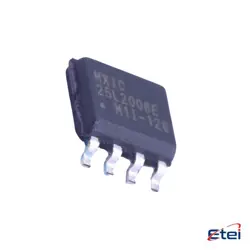
Images are for reference only
GD25Q16CSIGR
+BOMIC FLASH 16MBIT SPI/QUAD 8SOP
-
ManufacturerGigaDevice Semiconductor (HK) Limited
-
Mfr. Part #GD25Q16CSIGR
-
Package 8-SOIC (0.209, 5.30mm Width)
-
In Stock2672
365 Days Quality Guarantee
7*24 hours service quarantee
90-day after-sales guarantee
Genuine Product Guarantee
Specifications
| Attribute | Value |
| Package | Tape & Reel (TR),Cut Tape (CT) |
| ProductStatus | Not For New Designs |
| MemoryType | Non-Volatile |
| MemoryFormat | FLASH |
| Technology | FLASH - NOR |
| MemorySize | 16Mb (2M x 8) |
| MemoryInterface | SPI - Quad I/O |
| ClockFrequency | 120 MHz |
| WriteCycleTime-WordPage | 50µs, 2.4ms |
| Voltage-Supply | 2.7V ~ 3.6V |
| OperatingTemperature | -40°C ~ 85°C (TA) |
| MountingType | Surface Mount |
| Package/Case | 8-SOIC (0.209, 5.30mm Width) |
Overview
Description
The device is packaged in an 8-pin SOP (Small Outline Package), which is compact and facilitates easy integration into circuit boards. It supports a wide operating temperature range, making it suitable for industrial applications. Key features include support for fast read commands, sector and block erase, and advanced security options like write protection. Its versatility and robust performance make it a popular choice for developers seeking reliable non-volatile memory solutions.
Equivalent
1. Winbond W25Q16JV
2. Micron M25P16
3. Macronix MX25L1606E
4. ISSI IS25LP016D
5. Atmel/Microchip AT25SF161
These chips generally offer similar storage capacity, interface, and package type, making them suitable substitutes in most applications. Always verify pin compatibility and specific electrical characteristics before substituting.
Features
1. Memory Capacity: It provides 16 Mbit (2 MB) of storage, suitable for embedded systems requiring non-volatile storage.
2. Interface: It utilizes a Serial Peripheral Interface (SPI) for communication, supporting standard, dual, and quad SPI modes for flexible data transfer speeds.
3. Clock Frequency: The chip supports clock frequencies up to 104 MHz, enabling fast data access and programming operations.
4. Voltage Range: It operates within a wide voltage range of 2.7V to 3.6V, making it suitable for various power supply configurations.
5. Erase and Write: Features include sector erase (4K bytes), block erase (32K and 64K bytes), and a full chip erase for versatile data management. It also supports page programming (256 bytes per page).
6. Endurance and Retention: The memory offers high endurance with up to 100,000 program/erase cycles and data retention of 20 years, ensuring reliability over time.
7. Package: Available in a compact 8-pin SOP package, it is suitable for space-constrained applications.
These features make the GD25Q16CSIGR ideal for applications requiring reliable and efficient non-volatile memory storage.
Pinout
1. CS# (Chip Select): Activates the device when low.
2. SO (Serial Data Output): Outputs data from the device.
3. WP# (Write Protect): When low, it disables certain write operations to protect data.
4. VSS (Ground): Ground reference for the power supply.
5. SI (Serial Data Input): Inputs data into the device.
6. SCK (Serial Clock): Provides the clock signal to synchronize data transmission.
7. HOLD# (Hold): Pauses communication while active low, allowing other devices to share the SPI bus.
8. VCC (Power Supply): Provides power to the device.
These pins are designed to interface with a microcontroller or other controlling device using the SPI protocol, allowing for efficient read, write, and erase operations. The GD25Q16CSIGR is commonly used in embedded systems for data storage and retrieval.
Manufacturer
GigaDevice is particularly recognized for its NOR Flash, NAND Flash, and MCUs based on ARM Cortex-M cores, which are widely used in embedded systems and IoT devices. The company's products are designed to deliver high performance, reliability, and efficiency to meet the demands of modern electronic systems. As a fabless semiconductor company, GigaDevice focuses on design and innovation, while partnering with leading foundries for manufacturing.
Application
1. Consumer Electronics: Used in devices like TVs, set-top boxes, and gaming consoles for firmware storage.
2. IoT Devices: Provides storage for smart home devices, wearables, and other IoT gadgets.
3. Embedded Systems: Used in microcontroller-based systems for code and data storage.
4. Networking Equipment: Utilized in routers and switches for storing configurations and boot code.
5. Automotive: Employed in infotainment systems and electronic control units (ECUs).
6. Industrial Automation: Supports programmable logic controllers (PLCs) and human-machine interfaces (HMIs).
Its small size and low power consumption make it ideal for compact and energy-efficient applications.