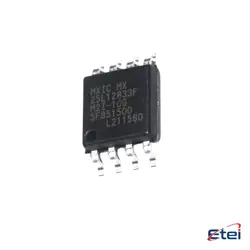
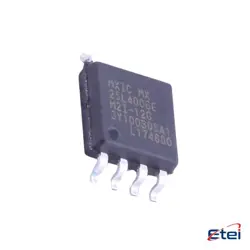
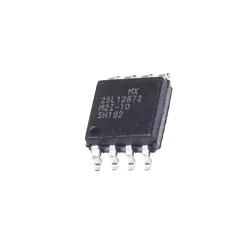
Images are for reference only
GD25Q40CTIGR
+BOMIC FLASH 4MBIT SPI/QUAD I/O 8SOP
-
ManufacturerGigaDevice Semiconductor (HK) Limited
-
Mfr. Part #GD25Q40CTIGR
-
Package 8-SOIC (0.154, 3.90mm Width)
-
In Stock7421
365 Days Quality Guarantee
7*24 hours service quarantee
90-day after-sales guarantee
Genuine Product Guarantee
Specifications
| Attribute | Value |
| Package | Tape & Reel (TR),Cut Tape (CT) |
| ProductStatus | Not For New Designs |
| MemoryType | Non-Volatile |
| MemoryFormat | FLASH |
| Technology | FLASH - NOR |
| MemorySize | 4Mb (512K x 8) |
| MemoryInterface | SPI - Quad I/O |
| ClockFrequency | 104 MHz |
| WriteCycleTime-WordPage | 50µs, 2.4ms |
| Voltage-Supply | 2.7V ~ 3.6V |
| OperatingTemperature | -40°C ~ 85°C (TA) |
| MountingType | Surface Mount |
| Package/Case | 8-SOIC (0.154, 3.90mm Width) |
Overview
Description
The device supports the Serial Peripheral Interface (SPI) protocol, which includes standard, dual, and quad SPI operations, allowing for flexible and high-speed data communication. It features a fast read performance with a maximum clock frequency of up to 104 MHz. The GD25Q40CTIGR also offers important functions like sector erase, block erase, and chip erase, which are essential for managing the memory efficiently.
With its small form factor, typically provided in an 8-pin SOP or other compact packaging options, it is suited for space-constrained applications. Its robust design and reliability make it ideal for use in consumer electronics, industrial control, and other embedded system applications.
Equivalent
1. Winbond W25Q40CL: Another 4Mb serial NOR Flash memory with similar specifications.
2. Micron M25P40: A 4Mb SPI NOR Flash memory.
3. Microchip SST25VF040B: A 4Mb serial Flash memory chip.
4. Cypress (Infineon) S25FL204K: A 4Mb serial Flash memory.
These equivalents are based on storage capacity and interface compatibility. Always verify specifications for exact requirements.
Features
1. Memory Capacity: 4 megabits, organized as 512K x 8 bits.
2. Interface: Utilizes a Serial Peripheral Interface (SPI) for communication, supporting modes 0 and 3.
3. Clock Frequency: Supports up to 104 MHz for fast data access and transfer.
4. Dual/Quad I/O: Offers dual and quad I/O modes for enhanced performance.
5. Sector Architecture: Divided into 4KB sectors, 32KB blocks, and 64KB blocks for flexible erase and program operations.
6. Low Power Consumption: Features a deep power-down mode to minimize energy use when inactive.
7. Wide Operating Voltage: Operates over a voltage range of 2.7V to 3.6V, suitable for various applications.
8. Endurance: Supports up to 100,000 program/erase cycles per sector.
9. Data Retention: Ensures data retention for up to 20 years.
10. Temperature Range: Operates in an industrial temperature range, typically from -40°C to +85°C.
The GD25Q40CTIGR is suitable for use in consumer electronics, industrial devices, and other applications requiring reliable and efficient non-volatile memory.
Pinout
1. CS# (Chip Select): Active low input that enables or disables the device.
2. MOSI (Master Out Slave In) / IO0: Serial data input pin for receiving instructions, addresses, and data.
3. WP# (Write Protect) / IO2: Used to protect the status register.
4. GND: Ground reference.
5. MISO (Master In Slave Out) / IO1: Serial data output pin for sending data to the master.
6. SCLK (Serial Clock): Provides the clock input for the data transfer.
7. HOLD# / IO3: Used to pause the operation without deselecting the device.
8. VCC: Power supply pin.
The GD25Q40CTIGR is used in applications requiring non-volatile storage that is easy to interface with, such as microcontroller systems, storing firmware, and data logging.
Manufacturer
Application
1. Consumer Electronics: Used in devices like TVs and set-top boxes for firmware storage.
2. Industrial Applications: Suitable for storing configuration data and logs in PLCs and industrial controllers.
3. Automotive Systems: Employed in infotainment systems and for ECU data storage.
4. IoT Devices: Provides non-volatile storage for firmware and system data.
5. Networking Equipment: Used in routers and switches for storing boot code and configuration settings.
Its small size, low power consumption, and durability make it ideal for embedded systems.