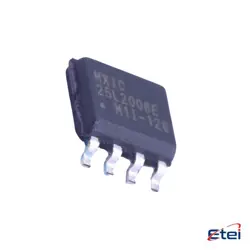
Images are for reference only
MCP23S18-E/SO
+BOMIC XPNDR 10MHZ SPI 28SOIC
-
ManufacturerMicrochip Technology
-
Mfr. Part #MCP23S18-E/SO
-
Datasheet MCP23S18-E/SO DataSheet
-
In Stock7472
365 Days Quality Guarantee
7*24 hours service quarantee
90-day after-sales guarantee
Genuine Product Guarantee
Specifications
| Attribute | Value |
| Part Status | Active |
| Base Product Number | MCP23S18 |
| DigiKey Programmable | Not Verified |
| Number of I/O | 16 |
| Interface | SPI |
| Interrupt Output | Yes |
| Output Type | Open Drain |
| Current - Output Source/Sink | 25mA |
| Clock Frequency | 10 MHz |
| Voltage - Supply | 1.8V ~ 5.5V |
| Operating Temperature | -40°C ~ 125°C |
| Mounting Type | Surface Mount |
| Package | 28-SOIC (0.295", 7.50mm Width) |
| Supplier Device Package | 28-SOIC |
| Packaging | Tube |
Overview
Description
Key features include interrupt output, which allows the microcontroller to be alerted about changes on the expander’s input pins, and a configurable address, enabling multiple devices to be used on the same SPI bus. The MCP23S18 supports up to 10 MHz SPI clock speed for fast communication. It also includes an internal configuration register and supports both input and output pin assignments, with options for pull-up resistors.
Packaged in a 28-pin SOIC, the MCP23S18-E/SO is compact and suitable for space-constrained applications. It is highly reliable, making it ideal for automotive, industrial, and consumer electronics where additional I/O is needed without increasing the microcontroller's size or complexity.
Equivalent
1. MCP23S17 – Another 16-bit SPI I/O expander by Microchip with similar features.
2. MCP23018 – An I2C variant offering similar functionality.
3. PCF8575 – A 16-bit I2C I/O expander by NXP.
4. TCA9539 – A 16-bit I2C I/O expander from Texas Instruments.
5. MAX7301 – A 20-port SPI I/O expander by Maxim Integrated.
These alternatives vary in communication protocol and additional features, so review specifications to ensure compatibility.
Features
1. 16-Bit I/O Port: It provides 16 general-purpose input/output pins that can be individually configured as inputs or outputs.
2. SPI Interface: Utilizes a Serial Peripheral Interface (SPI) for communication, supporting high-speed data transfer.
3. Interrupt Output: Includes interrupt capabilities with configurable interrupt-on-change on each pin, enhancing responsiveness to input changes.
4. High-Speed Operation: Supports SPI clock speeds up to 10 MHz, enabling fast data exchanges.
5. Low Standby Current: Features low power consumption, making it suitable for battery-operated devices.
6. Programmable Pull-Up Resistors: Internal pull-up resistors can be enabled for each input pin.
7. Wide Voltage Range: Operates over a voltage range of 1.8V to 5.5V, offering flexibility in various applications.
8. Multiple Address Pins: Supports up to 8 devices on the same bus through address pins, allowing easy expansion.
9. Package: Available in a 28-pin SOIC package, suitable for surface-mount applications.
These features make it ideal for expanding I/O ports in microcontroller-based systems.
Pinout
Key pin functions include:
- VDD: Power supply pin.
- VSS: Ground pin.
- SCK: Serial Clock input for SPI communication.
- SI: Serial Input data line (MOSI - Master Out Slave In).
- SO: Serial Output data line (MISO - Master In Slave Out).
- CS: Chip Select input to enable the device.
- RESET: Resets the device when driven low.
- INTA, INTB: Interrupt output pins for Port A and Port B.
- PORTA, PORTB: Two 8-bit wide ports (PA0-PA7, PB0-PB7) configured as input or output.
The MCP23S18-E/SO supports additional features like I/O direction control, pull-up resistors, and interrupt-on-change, providing flexibility for various applications.
Manufacturer
Application
1. Embedded Systems: Extending GPIO capabilities in microcontroller-based designs.
2. Consumer Electronics: Managing multiple peripheral components in devices like TVs and home appliances.
3. Industrial Automation: Controlling sensors, actuators, and other devices in PLCs and automated systems.
4. IoT Devices: Expanding connectivity options for smart home and industrial IoT applications.
5. Medical Devices: Enhancing interfacing capabilities in diagnostic and monitoring equipment.
Its use of the SPI interface ensures efficient communication in systems where minimal pin usage and fast data transfer are critical.