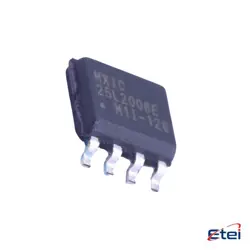
Images are for reference only
MCP4921-E/SN
+BOMIC DAC 12BIT V-OUT 8SOIC
-
ManufacturerMicrochip Technology
-
Mfr. Part #MCP4921-E/SN
-
Datasheet MCP4921-E/SN DataSheet
-
Package SOIC-8
-
In Stock3851
365 Days Quality Guarantee
7*24 hours service quarantee
90-day after-sales guarantee
Genuine Product Guarantee
Specifications
| Attribute | Value |
| Package | Tube |
| ProductStatus | Active |
| NumberofBits | 12 |
| NumberofD/AConverters | 1 |
| SettlingTime | 4.5µs (Typ) |
| OutputType | Voltage - Buffered |
| DifferentialOutput | No |
| DataInterface | SPI |
| ReferenceType | External |
| Voltage-SupplyAnalog | 2.7V ~ 5.5V |
| Voltage-SupplyDigital | 2.7V ~ 5.5V |
| INL/DNL(LSB) | ±4, ±0.25 |
| Architecture | String DAC |
| OperatingTemperature | -40°C ~ 125°C |
| Package/Case | 8-SOIC (0.154, 3.90mm Width) |
| SupplierDevicePackage | 8-SOIC |
Overview
Description
Key features include a wide operating voltage range from 2.7V to 5.5V, low power consumption, and a fast settling time, which makes it ideal for battery-powered and high-speed applications. The MCP4921 has a rail-to-rail output and includes an integrated precision reference to maintain accuracy across its operating conditions.
The device comes in an 8-pin SOIC package, making it compact and easy to incorporate into various circuit designs. With a maximum output current of 25 mA, it is suitable for driving small loads directly. The MCP4921 is commonly used in applications like waveform generation, digital calibration, and automated test equipment due to its combination of precision, ease of use, and cost-effectiveness.
Equivalent
1. MCP4922 - A dual version of the MCP4921.
2. AD5321 by Analog Devices - Similar single-channel DAC.
3. MAX517 by Maxim Integrated - Offers similar functionality.
4. DAC121S101 by Texas Instruments - Another 12-bit DAC option.
5. TLV5618 by Texas Instruments - Dual 12-bit DAC with similar features.
Always check specific requirements like pin configuration and voltage range when selecting an equivalent.
Features
1. Resolution: 12-bit, providing high precision for analog signal generation.
2. Output Voltage: Rail-to-rail output for maximum dynamic range.
3. SPI Interface: Serial Peripheral Interface (SPI) for easy integration with microcontrollers.
4. Speed: High-speed DAC with fast settling time to accommodate dynamic applications.
5. Package: Available in an 8-pin SOIC package, offering compact size for embedded systems.
6. Supply Voltage: Operates from a single supply voltage ranging from 2.7V to 5.5V.
7. Temperature Range: Industrial temperature range from -40°C to +85°C, suitable for various environments.
8. Low Power Consumption: Optimized for low power applications, making it suitable for battery-operated devices.
9. Buffered Output: Internal output buffer for driving capacitive loads without external components.
10. Glitch-Free Operation: Minimizes output glitches during digital code transitions.
These features make the MCP4921-E/SN ideal for applications requiring precise analog signal generation, such as audio, instrumentation, and control systems.
Pinout
1. Pin 1 (CS): Chip Select - Active low input that enables communication with the DAC.
2. Pin 2 (SCK): Serial Clock Input - Used to clock in data to the device.
3. Pin 3 (SDI): Serial Data Input - Transmits data to the DAC.
4. Pin 4 (VSS): Ground - Connect to the negative supply voltage.
5. Pin 5 (VDD): Positive Supply Voltage - Typically requires 2.7V to 5.5V.
6. Pin 6 (VOUT): Analog Output Voltage - Outputs the analog signal corresponding to the digital input.
7. Pin 7 (LDAC): Latch DAC Input - Active low pin used to update the output when multiple DACs are used.
8. Pin 8 (NC): No Connection - Not internally connected and usually left unconnected.
The MCP4921 provides high precision with a low power consumption making it suitable for various applications including instrumentation and control systems.
Manufacturer
Application
1. Audio Equipment: Used for audio signal generation and processing.
2. Industrial Control Systems: Provides control signals for actuators and sensors.
3. Data Acquisition Systems: Converts digital data to analog signals for monitoring and analysis.
4. Signal Generation: Used in function generators and waveform synthesizers.
5. Instrumentation: Provides accurate voltage outputs for test and measurement equipment.
6. Communication Systems: Assists in modulation and signal processing tasks.
7. Embedded Systems: Enhances microcontroller-based applications with analog output capabilities.
Its high-performance and low-power characteristics make it suitable for a wide range of precision applications.