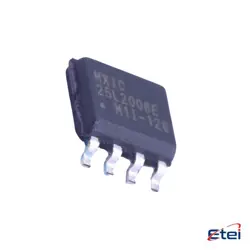
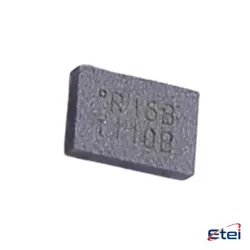
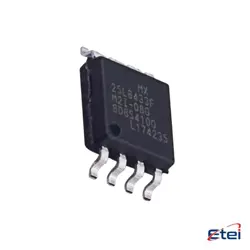
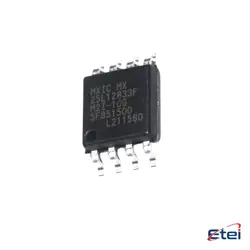
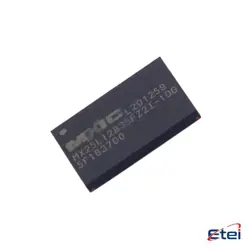
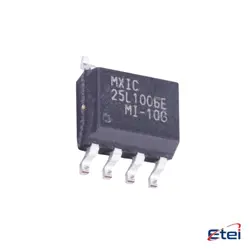
Images are for reference only
MX25V5126FZUI
+BOMIC FLSH 512KBIT SPI/DUAL 8USON
-
ManufacturerMacronix
-
Mfr. Part #MX25V5126FZUI
-
Datasheet MX25V5126FZUI DataSheet
-
Package UFDFN-8
-
In Stock3312
365 Days Quality Guarantee
7*24 hours service quarantee
90-day after-sales guarantee
Genuine Product Guarantee
Specifications
| Attribute | Value |
| Package / Case | Tape & Reel (TR),Cut Tape (CT) |
| Series | MXSMIO™ |
| Part Status | Active |
| Memory Type | Non-Volatile |
| Memory Format | FLASH |
| Technology | FLASH - NOR |
| Memory Size | 512Kb (64K x 8) |
| Memory Interface | SPI - Dual I/O |
| Clock Frequency | 80 MHz |
| Write Cycle Time - Word Page | 50µs, 10ms |
| Voltage - Supply | 2.3V ~ 3.6V |
| Operating Temperature | -40°C ~ 85°C (TA) |
| Mounting Type | Surface Mount |
Overview
Description
Key features of the MX25V5126FZUI include a low-voltage operation, typically around 1.8 volts, which makes it ideal for battery-powered and low-power applications. It supports the Serial Peripheral Interface (SPI), which allows for easy integration with microcontrollers and other digital components. The chip also provides features like fast read speeds, sector erase, and write protection, enhancing its versatility and reliability in various applications.
With its compact size and efficient power consumption, the MX25V5126FZUI is well-suited for use in consumer electronics, industrial control systems, and automotive applications where reliable and efficient data storage is essential.
Equivalent
1. Winbond W25X05CL - Offers similar features and specifications as a 512Kb NOR Flash.
2. Microchip SST25VF512A - A compatible 512Kb serial Flash memory device.
3. Adesto AT25DN512C - Another 512Kb NOR Flash memory with comparable attributes.
These alternatives should be verified for compatibility regarding specific application requirements such as voltage, package type, and speed.
Features
1. Memory Organization: 512Kb (64KB x 8) of memory, suitable for small-scale data storage requirements.
2. Data Transfer: Utilizes SPI (Serial Peripheral Interface) for data transfer, supporting standard, fast, dual, and quad SPI modes to achieve varying speeds.
3. Voltage Range: Operates on a wide voltage range from 1.65V to 3.6V, providing flexibility for different power configurations.
4. Low Power Consumption: Designed for low power consumption, ideal for battery-operated devices.
5. Performance: High-performance read speeds, with the capability to execute fast read operations.
6. Erase/Program Cycles: Supports sector and block erase commands, with a high endurance for erase/program cycles.
7. Security Features: Includes features like block protection and a write-protect pin to ensure data integrity and security.
8. Temperature Range: Offers a wide operating temperature range, making it suitable for various environmental conditions.
These features make it ideal for applications requiring reliable, compact, and efficient memory solutions.
Pinout
1. CS# (Chip Select): Activates the device when low; otherwise, it is in standby mode.
2. SCLK (Serial Clock): Provides clock input for data transactions.
3. SI (Serial Input)/IO0: Accepts data input and instructions in SPI mode.
4. SO (Serial Output)/IO1: Outputs data in SPI mode; used for dual I/O operations.
5. WP# (Write Protect)/IO2: Provides hardware write protection; serves as an I/O pin in quad I/O mode.
6. HOLD#/RESET#/IO3: Pauses serial communication temporarily; also used as an I/O pin or reset in certain modes.
7. VCC: Supplies power to the chip, typically 1.7V to 2.0V.
8. VSS: Ground reference for the power supply.
The MX25V5126FZUI is designed for embedded systems requiring reliable and efficient non-volatile memory storage with a small footprint.
Manufacturer
Application
1. Consumer Electronics: Used in devices like TVs, set-top boxes, and cameras for firmware storage.
2. Industrial Automation: Employed in programmable logic controllers (PLCs) and human-machine interfaces (HMIs).
3. Automotive Systems: Used for infotainment systems, dashboard displays, and advanced driver-assistance systems (ADAS).
4. Networking Equipment: Found in routers, switches, and modems for configuration data and boot code.
5. IoT Devices: Utilized for firmware updates and system configurations in smart devices.
These applications benefit from the chip's fast read speeds and low power consumption.