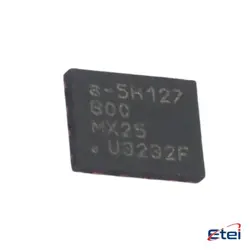
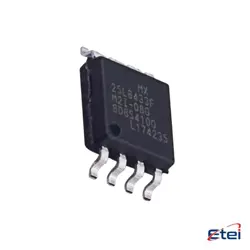
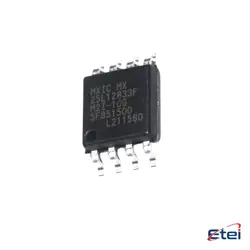
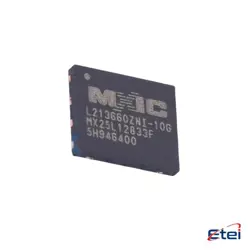
Images are for reference only
PCA9555DWR
+BOMIC XPNDR 400KHZ I2C SMBUS 24SOIC
-
ManufacturerTexas Instruments
-
Mfr. Part #PCA9555DWR
-
Datasheet PCA9555DWR DataSheet
-
In Stock9640
365 Days Quality Guarantee
7*24 hours service quarantee
90-day after-sales guarantee
Genuine Product Guarantee
Specifications
| Attribute | Value |
| PartStatus | Active |
| DigiKeyProgrammable | Not Verified |
| NumberofI/O | 16 |
| Interface | I2C, SMBus |
| InterruptOutput | Yes |
| Features | POR |
| OutputType | Push-Pull |
| Current-OutputSource/Sink | 10mA, 25mA |
| ClockFrequency | 400 kHz |
| Voltage-Supply | 2.3V ~ 5.5V |
| OperatingTemperature | -40°C ~ 85°C |
| MountingType | Surface Mount |
| Package/Case | 24-SOIC (0.295", 7.50mm Width) |
| SupplierDevicePackage | 24-SOIC |
| BaseProductNumber | PCA9555 |
Overview
Description
Key features of the PCA9555DWR include its ability to operate over a wide voltage range (2.3V to 5.5V), low current consumption, and the capability to drive LEDs directly without needing additional current-limiting resistors. It supports up to eight PCA9555 devices on the same I2C bus, allowing for scalability. The device features interrupt output for external devices and configurable I/O pins as inputs or outputs. Its package is designed for ease of use and integration into various applications, with surface-mount options available for compact design requirements.
Equivalent
1. NXP PCA9555: Offers similar functionalities and is a direct equivalent.
2. Texas Instruments TCA9535: Provides comparable I/O expansion capabilities with a similar interface.
3. Microchip MCP23017: Another I2C I/O expander with 16-bit I/O, similar to the PCA9555.
4. On Semiconductor CAT9555: Features similar I2C interface and I/O expansion functions.
These alternatives provide comparable functionality for expanding I/O in microcontroller applications.
Features
1. I²C Interface: Supports standard (100 kHz) and fast (400 kHz) I²C communication speeds.
2. 16 I/O Pins: Configurable as inputs or outputs, allowing for versatile application usage.
3. Interrupt Output: Provides an interrupt feature that alerts the microcontroller of state changes in the I/O pins.
4. Polarity Inversion: Each input can be configured to invert the polarity, offering more flexibility in signal processing.
5. Low Standby Current: Helps in reducing power consumption when the device is in idle mode.
6. Wide Supply Voltage Range: Operates from 2.3 V to 5.5 V, making it suitable for various applications.
7. Open-Drain Outputs: Enables wired-AND configurations and interfacing with other devices.
8. Temperature Range: Supports operation from -40°C to +85°C, suitable for industrial environments.
9. Daisy-Chaining: Multiple devices can be placed on the same I²C bus.
This expander is ideal for applications requiring additional I/O without increasing the complexity of the microcontroller.
Pinout
1. Power and Ground: VCC and GND pins for power supply.
2. I²C Interface: Include pins for SDA (data line) and SCL (clock line) to facilitate I²C communication.
3. Interrupt Output: Two interrupt pins, INT A and INT B, to alert the microcontroller of input state changes.
4. Reset: A reset pin (RESET) to initialize the device.
5. Address: Three address pins (A0, A1, A2) to set the I²C-bus slave address for interfacing with multiple devices.
6. GPIO Ports: Two 8-bit ports (P0 and P1), each with 8 pins, serve as the ports for input-output operations.
The PCA9555DWR allows for additional GPIO pins to be added to a microcontroller, extending functionality while using only the two-wire I²C interface.
Manufacturer
Application
1. Industrial Automation: Extends GPIO for monitoring and controlling machinery.
2. Consumer Electronics: Enhances input/output capabilities in devices such as televisions and home appliances.
3. Embedded Systems: Provides additional I/O ports for sensors and actuators in embedded applications.
4. Networking Equipment: Manages LED indicators and control signals in routers and switches.
5. Automotive Systems: Facilitates control and monitoring functions in vehicle electronics.
6. Home Automation: Increases control interfaces for smart home devices.
These applications benefit from the PCA9555DWR's ability to control multiple I/O lines via a simple I2C interface.